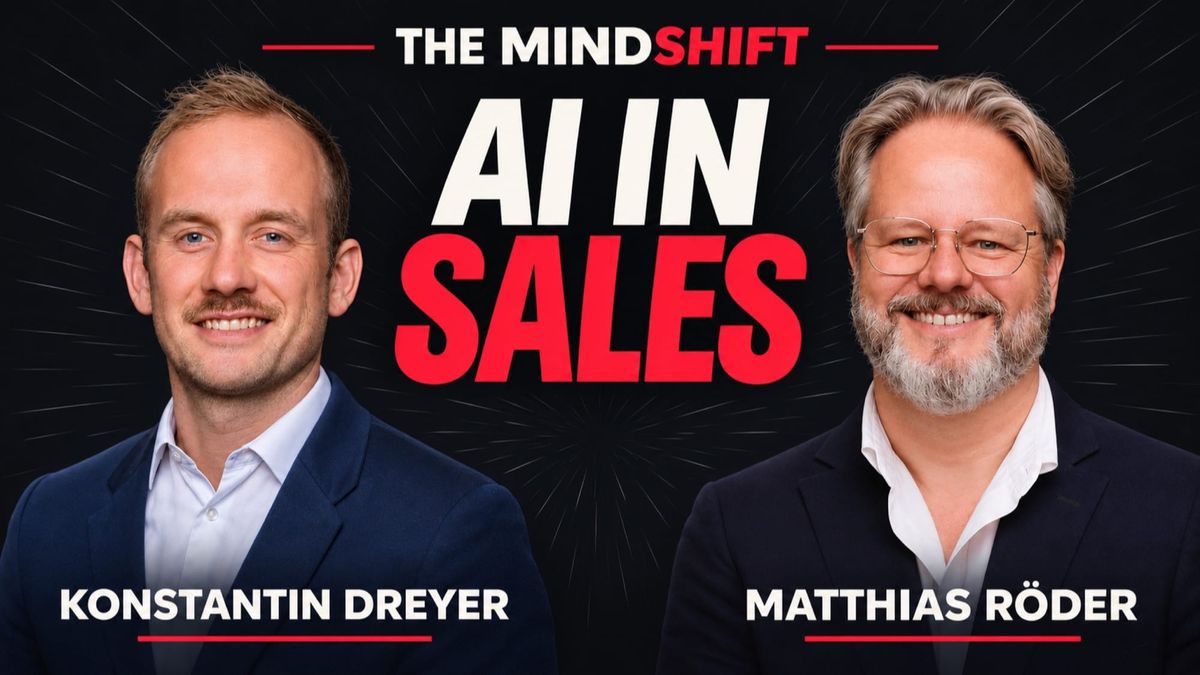
AI in Sales: From Cold Outreach to Buying Signals — with Konstantin Dreyer
Konstantin Dreyer on buying signals, weekly Claude research and the decisions he keeps human in industrial sales.
A company can be a perfect fit for your product and still have no reason to buy it today. Finding out what has changed may be the most useful part of the sales process to give to AI.
That was the thread I wanted to follow with Konstantin Dreyer. He works in the Dreyer family office, looking at investments in the German-speaking region, and also works on sales for an industrial portfolio company. His examples come from the everyday work of finding customers, understanding what they need and keeping a conversation moving.
Earlier in his career, that meant driving across western Austria, talking to factories and trying to find the right person for pumps and heat exchangers. He knows how much work can go into reaching a company before you know whether there is a useful conversation to have.
In our conversation, he described a more focused approach: look for evidence that a company might need something now, then decide whether to get in touch.
What counts as a buying signal?
Konstantin groups the signals into three categories.
Something changes inside a company. A new factory, production line or product can create a need that wasn't there before. An investment announcement may give you a reason to look more closely.
Something changes in a market. Growth in a relevant industry can help you decide where to spend your research time. It gives you a direction to investigate, rather than proof that any particular company is ready to buy.
Someone changes roles. A new head of procurement or managing director may be reviewing suppliers and priorities. Whether that makes your offer relevant still needs judgment.
The point is to define what you are looking for in terms of the customer's situation. Once you can describe a useful signal, you can ask AI to help you watch for it.
A weekly report, followed by a human decision
Konstantin uses recurring tasks and connectors in Claude. Every Monday, he receives a report covering five main industries. The workflow also helps prepare messages, create opportunities in the CRM and keep track of follow-ups.
He reads the material and decides what gets sent. If a prospect isn't relevant, it comes out of the process. If there is a useful response, the conversation moves into the sales pipeline. Follow-up is part of the workflow, including a reminder after two weeks.
I like the clarity of that division. AI helps keep a broad search running and turns findings into something a person can act on. The person remains responsible for understanding whether the proposed conversation makes sense.
We did not establish a measured increase in sales or conversion rates. What Konstantin shared was the way he works: a concrete example of connecting research, decisions and follow-through.
The factory still has to know its own answers
This led us to the limits of autonomy. Could an AI system take a customer from first contact all the way through to an order?
In the business Konstantin described, important information still sits with people. Pricing, production capacity and delivery dates are not all available to an agent as dependable, connected data.
That matters when a system is expected to make a promise to a customer. A fluent answer doesn't establish that the factory can deliver the product on time. Before handing over more responsibility, the business needs to make its own information available and trustworthy.
For anyone trying this, I would start with one recurring research task. Decide what evidence would make a lead worth your time, check the findings, and see whether they produce better conversations. You can learn a lot before connecting the system to every part of the business.
A second example: a website in nine languages
Konstantin also described using Claude's browser extension to work on a Webflow website. He wanted English pages that search engines could find, rather than relying only on on-demand translation.
He said the English version took about half an hour, followed by seven more languages, bringing the site to nine languages including German. He reviewed the work before publishing it.
That is his account of the project. We did not audit the implementation, translation accuracy or search performance. What I found useful was the practical route: describe a problem, let an agent work inside an existing tool, and check the result before making it public.
Keep the thinking
We ended up talking about ideas, execution and competitive advantage. When more people can turn an idea into a working process, deciding what is worth building becomes a larger part of the work.
Konstantin's advice near the end was simple: don't outsource the thinking. Keep learning what the tools can do, while keeping your own judgment active.
His sales example gives that advice a useful shape. Understand the customer, define the signal, and decide what deserves a response. Then give AI a clear part of the work to carry.
Listen to the full 29-minute conversation with Konstantin Dreyer, with chapters and show notes.
Matthias