Where Humans Belong In Agent Workflows
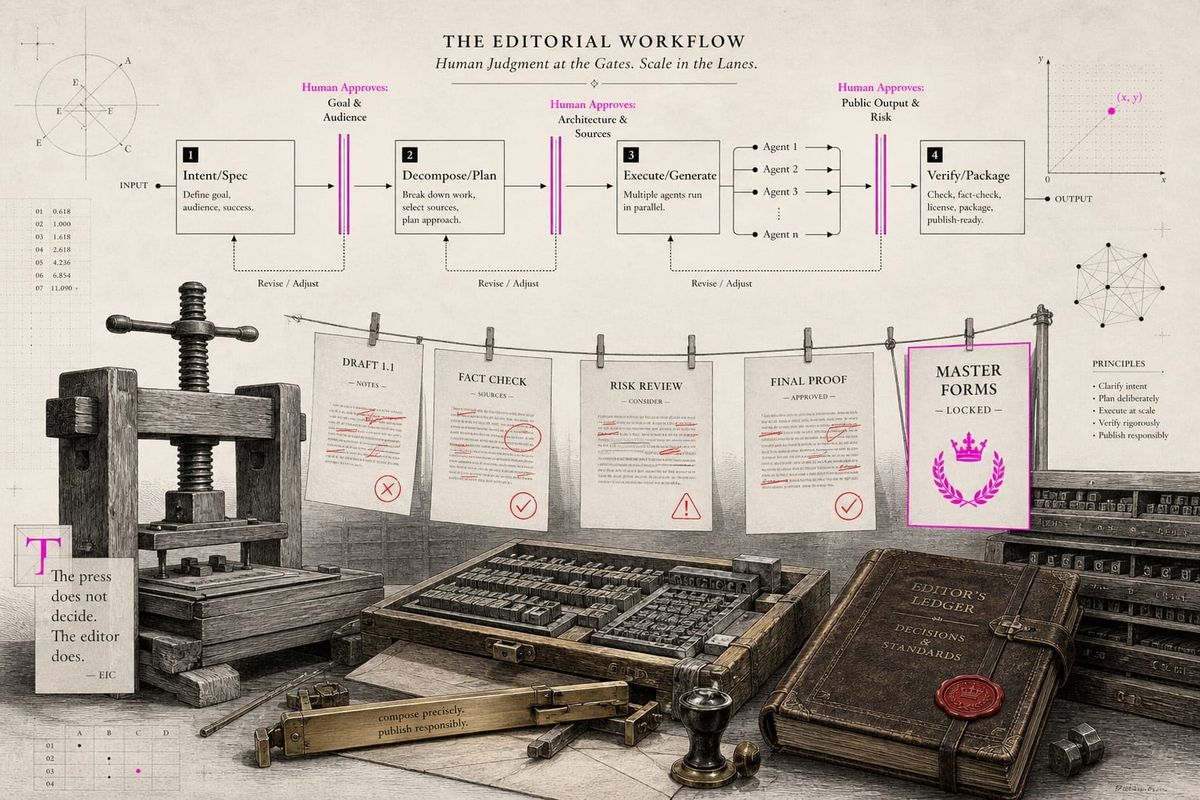
AI agents should not be supervised everywhere or trusted nowhere. The useful pattern is human checkpoints: clear places where judgment, risk, and publication decisions stay with you.
Hello and welcome (back) to The Mindshift AI Inference!
When people first work with AI, they often become the bottleneck. They ask the AI to do something, then inspect every sentence, every file, every option, and every intermediate step.
This feels responsible, but it does not scale.
The opposite mistake is worse. You let the AI run too far without checkpoints, it makes assumptions, those assumptions compound, and by the time you see the output it may be polished, coherent, and wrong.
So the question is not whether humans should be involved. The question is where.
Human Checkpoints
A human checkpoint is a deliberate pause where the human makes a decision that should not be delegated.
Approve the goal, the audience, the strategic frame, the architecture, the sources, and the public output. Approve anything that spends money, sends messages, changes relationships, or affects reputation.
That is different from micromanaging the whole process. It puts human judgment at the points where judgment matters most.
The Software Factory Example
Software makes this easy to see. A useful agentic software workflow does not begin with “go build the thing.” It begins with a spec.
What are we building? Who is it for? What should be true when it is done? What are the acceptance criteria?
An agent can draft the spec. Another can turn it into tasks. Another can implement. Another can test. Another can review. But the human should approve the core intent before implementation begins.
Otherwise the agents may build the wrong thing very efficiently.
Creative Work Is The Same
If you ask AI to write an article, the most important checkpoint is not comma placement. It is the claim.
What is the piece trying to say? Who is it for? What should the reader understand differently afterward?
Once that is clear, AI can draft, review, revise, and format. But if the claim is weak, the workflow will only produce a polished weak article.
The Human As Editor-In-Chief
In a multi-agent workflow, the human becomes less like a typist and more like an editor-in-chief. The editor-in-chief does not write every sentence. The editor-in-chief decides what belongs in the publication.
What is the standard? What is the voice? What is the risk? What should be killed?
The question is not whether the AI can do it. The question is at which point the AI should stop and ask.
Design that line well, and the workflow becomes powerful.
Have a great day!
Matthias
P.S. For Explorer and Pioneer members, I also wrote the practical version: How To Run Human Checkpoints With A Software Factory. It includes my software-factory checkpoint model and a downloadable skill template you can adapt. The "Explorer" tier gives you these deeper guides and templates; the "Pioneer" tier adds a monthly 20-minute call slot with me where we can look at your own setup together.