Why Your AI Second Brain Needs GitHub
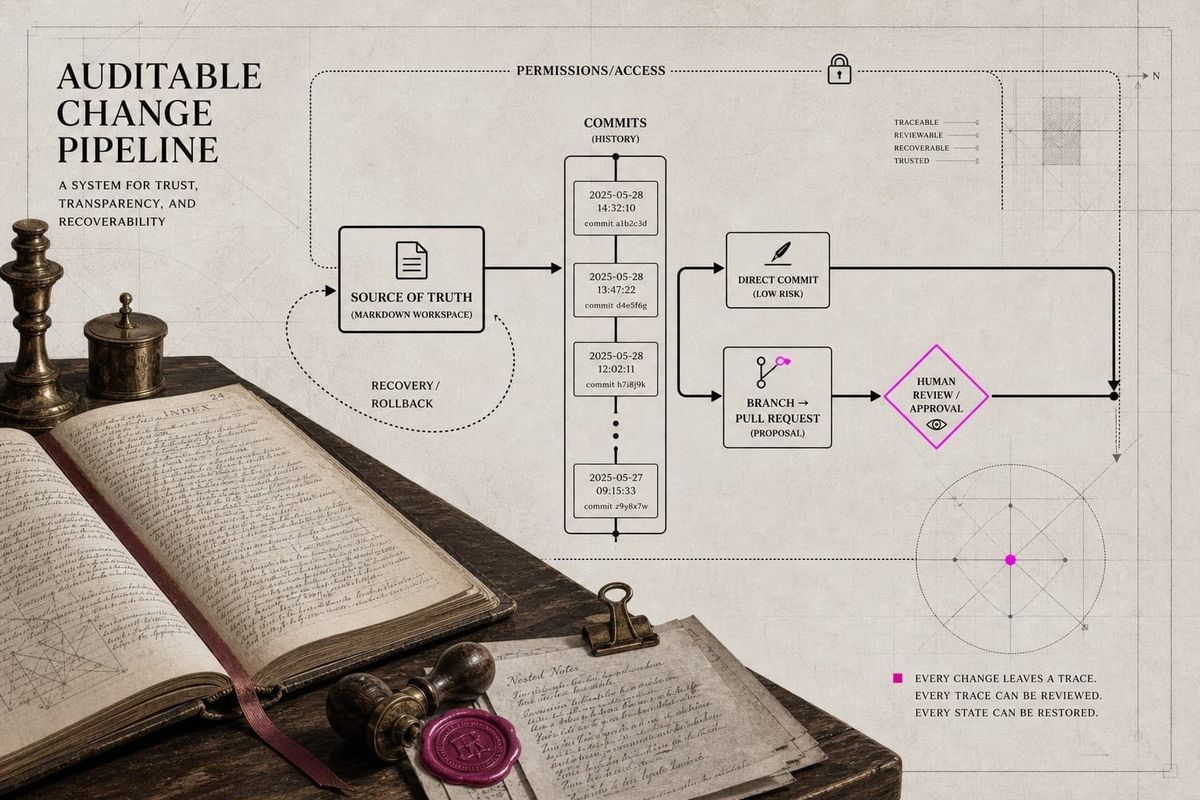
If AI agents are going to work inside your second brain, the system needs history, review, and recovery. That is why GitHub matters beyond code.
Hello and welcome (back) to The Mindshift AI Inference!
Most people still think GitHub is where programmers keep code.
That is true, but it is no longer the whole story.
If you are building an AI Second Brain, GitHub becomes useful for a different reason: it gives your knowledge system history.
That sounds like a small thing. It is not.
Once you allow AI agents to work with your files, your Second Brain is no longer just a private collection of notes. It becomes a workspace where humans and machines can read, write, summarize, reorganize, draft, and improve material together.
At that point, the question changes.
It is no longer only: where do I store my knowledge?
It becomes: how do I know what changed?
A folder is not enough
A folder can hold notes, drafts, research, project plans, workshop material, customer previews, and instructions for agents. That is useful. It is also the right starting point.
But a folder does not explain itself.
If an agent rewrites a project status file, adds a research summary, changes a draft, or updates a workflow instruction, you need to know what happened. Not in vague terms. You need to see the change.
This is the basic promise of Git and GitHub.
Git records the history of the files. GitHub gives you a place to inspect, review, and collaborate around that history.
You do not have to become a developer to benefit from this. You only need to understand the role it plays in the system.
Git is the memory of the files.
GitHub is the shared control room.
This is a knowledge-work problem now
Software teams adopted GitHub because code is fragile. Many people can work on the same project. Small changes can have large consequences. You need review before important changes become part of the official version.
AI brings the same pattern into knowledge work.
Your notes, drafts, briefs, research files, strategy documents, and project plans are becoming active material. Agents can change them. Collaborators can review them. Customers may receive selected outputs. Automations can add new files while you are offline.
That means knowledge work now needs some of the infrastructure software teams have used for years: history, review, permissions, rollback, and a clear source of truth.
This is why GitHub matters beyond coding.
It is not about turning everyone into a programmer. It is about making machine-assisted work inspectable.
Auditability creates trust
Many people are rightly cautious about letting AI agents touch real files.
If an agent changes your workspace and you cannot easily see what it did, you should be cautious. A black box that edits your knowledge system is not a good operating model.
GitHub gives you a healthier relationship with delegation.
An agent can propose a change. You can inspect it. You can ask another agent to review it. You can accept it, reject it, or go back to an earlier version. The work does not have to disappear into a chat transcript.
This matters most when the work affects memory, reputation, customers, public material, or project decisions.
The more your AI setup does, the more important the audit trail becomes.
Collaboration gets easier
The second benefit is collaboration.
An AI Second Brain starts as a personal tool. Over time, it becomes a collaboration surface.
A colleague may need to review a draft. A customer may need to see a moodboard or concept page. A researcher may add source material. An agent may prepare a pull request. Another agent may review the first agent’s work.
Without a shared system, this becomes messy quickly. Files get copied, links get lost, and nobody knows which version is the real one.
GitHub gives the work a stable object.
This branch. This change. This review. This version. This issue.
That is a better way to collaborate with both humans and machines.
The reframe
GitHub is not only a coding tool.
It is a control layer for any serious AI workspace.
If your agent can change files, those changes should leave a trace. If a change matters, a human should be able to inspect it. If the work becomes public, customer-facing, or part of long-term memory, it should go through review.
That is the simple operating rule.
Your Second Brain should not only store what you know. It should show how your thinking and your work changed over time.
That is what makes it auditable.
For paying members, I also wrote the practical setup guide: How To Make Your AI Second Brain Auditable With GitHub.
Have a great day!
Matthias