Agents Need A World, Not Just A Prompt
Better prompts are not enough for serious AI work. Agents become useful when they can inspect the state of a project, see what changed, and operate inside a shared world.
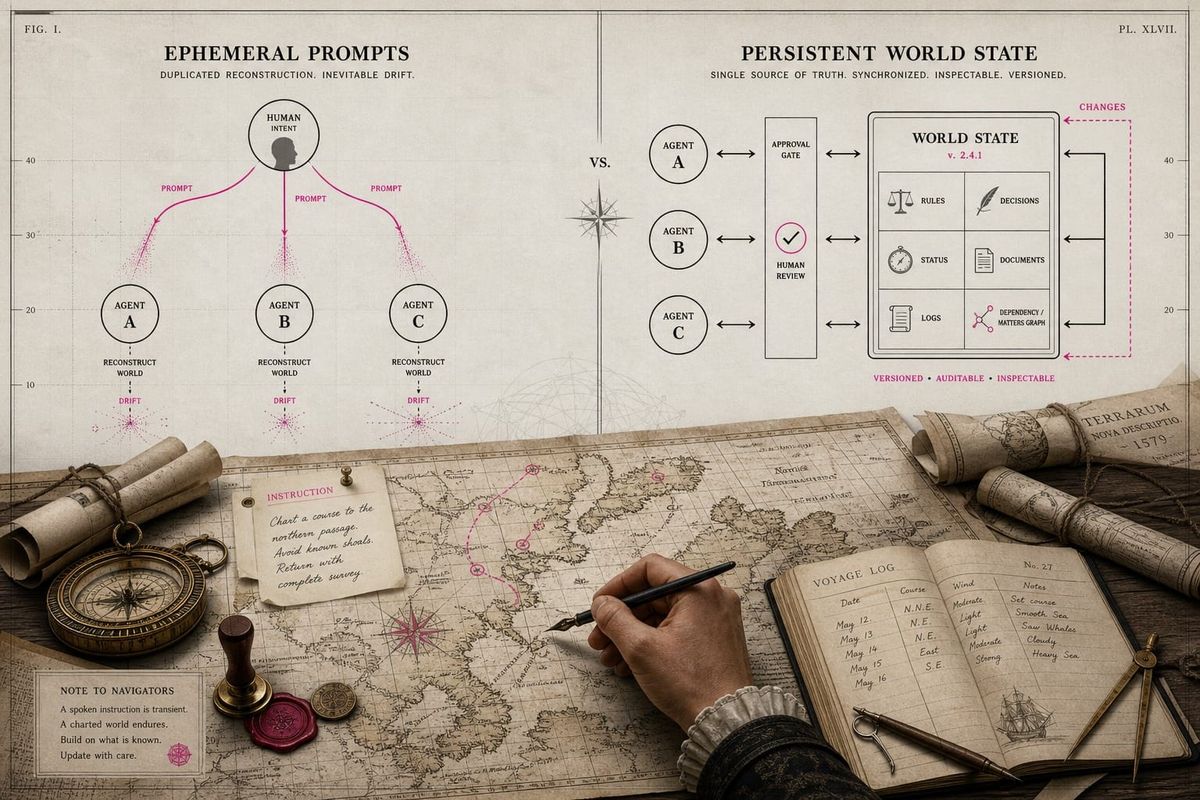
Agents Need A World, Not Just A Prompt
Hello and welcome (back) to The Mindshift AI Inference!
Most people still use AI as if it were a clever chat window. They open a conversation, ask a question, get an answer, and then carry the result back into the rest of their work.
That is useful, but it does not compound.
The chat forgets the project. It does not know which decision was made last week, which version is current, what is blocked, or what depends on what. If you want agents to help with serious work, they need more than a prompt.
They need a world.
What A World Means
A world is the inspectable state around the work. It is the project status, the open problems, the rules, the documents, and the logs of what has already happened.
This does not have to be complicated. In fact, the simpler it is, the better. The point is not to build a second brain that nobody understands. The point is to give agents a place to look before they act.
If an agent can inspect the state of a project, it can continue from where the work actually is. If it cannot, every request becomes a small reconstruction exercise.
The Prompt Is Not The Project
Imagine hiring an assistant and giving them one paragraph of context each morning. They cannot see the project brief, the latest decision, the unresolved problems, or the rules for what they are allowed to change.
They may still help, but they will never become deeply useful.
This is where many AI workflows get stuck. We keep improving the prompt, when the real limitation is the absence of a shared working environment.
The prompt is an instruction. The project is the world.
Why This Matters For Multi-Agent Work
The problem becomes sharper once you work with more than one agent. A research agent finds something. A writing agent drafts from old context. A reviewer points out a problem that was already decided. The human quietly becomes the synchronization layer.
That is not delegation. That is hidden coordination work.
Persistent world state changes this. Agents can orient themselves around the same map. They can see what matters, what has changed, what is blocked, and what should not be touched without approval.
The more agents you use, the more important this becomes.
Inspectable Beats Mysterious
I do not want my work to live only inside a vendor’s invisible memory system. I want state I can inspect, move, version, and correct.
If an agent updates a project, I should be able to see what changed. If it relies on a decision, I should be able to find the decision. If it marks something as resolved, I should be able to understand why.
If you can inspect it, you control it.
That is the heart of this shift. The next step in useful AI work is not just better prompts. It is better working environments.
Build the world first. Then let agents operate inside it.
Have a great day!
Matthias
P.S. For paying members, I also wrote the practical version: How To Design Persistent World State For Agents. It shows a minimal project structure with a matters graph, status file, rules, documents, and logs.