Better Work Design Comes First
Multi-agent workflows do not start with more agents. They start with better work design: separating responsibilities so creation, review, judgment, and context each have their place.
Hello and welcome (back) to The Mindshift AI Inference!
This week started with a simple question: what is the benefit of using multiple agents?
The tempting answer is: more intelligence. More agents, more perspectives, more output, more speed.
I do not think that is the right starting point.
The real benefit of multi-agent workflows is better work design. More specifically: separation of concerns.
Do not ask one AI to research, think, draft, review, remember, operate, and decide all at once. Separate the work. Give each part a clear role. Then decide where the human belongs.
That is the foundation. The agents come after.
What We Built This Week
On Monday, I wrote that we should stop chatting with AI and start delegating. An agent is not a personality. It is a role with context, tools, and boundaries.
On Tuesday, we looked at why AI writing needs a reviewer. Writing and reviewing are different jobs. The writer creates momentum; the reviewer creates distance.
On Wednesday, we asked where humans belong in agent workflows. The human should not inspect every tiny step. The human should approve the places where judgment, risk, reputation, money, or relationships are involved.
On Thursday, we saw that agents need a world, not just a prompt. If every agent starts from a prompt, the human becomes the memory. If the project has visible state, agents can orient themselves before they act.
Each piece was about AI. But underneath, each piece was about work design.
The Principle
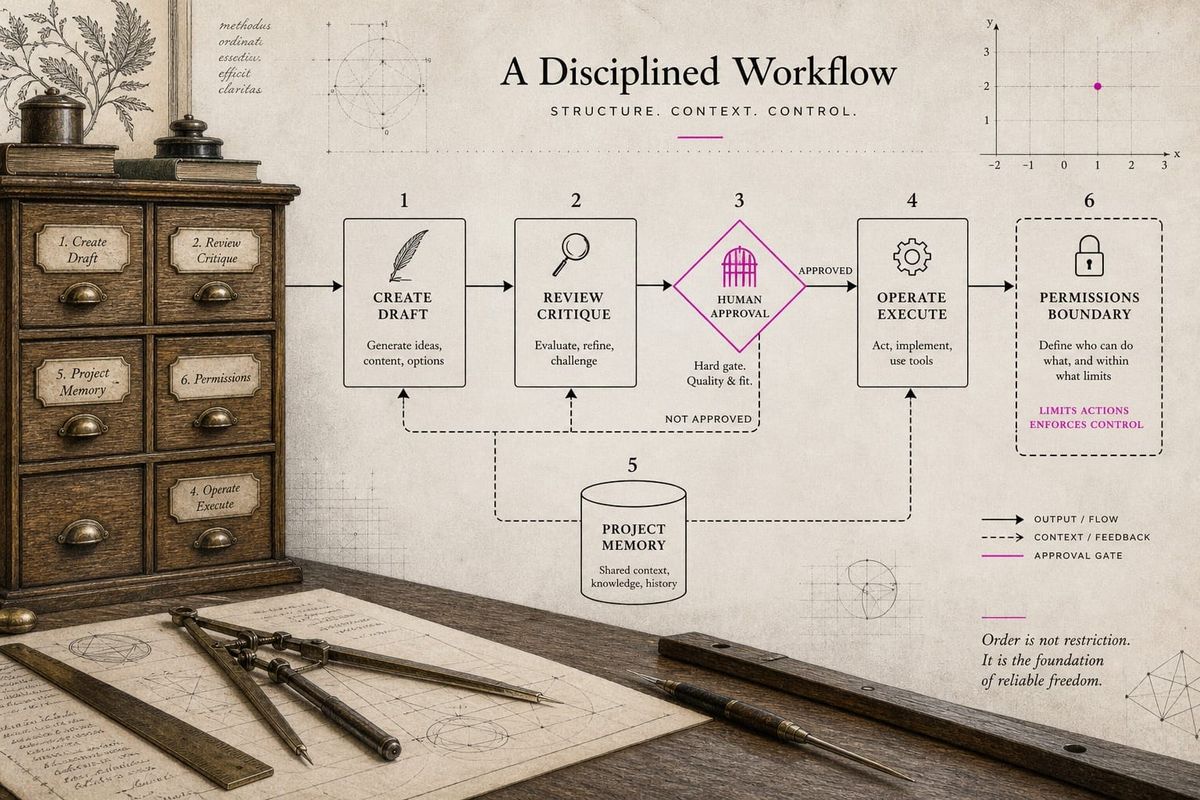
A working multi-agent workflow starts with a few simple separations.
Let one agent make the thing, and another agent review it. If I am writing an article, one agent can draft the piece and another can ask: where is the claim weak, where does this sound generic, and what would a smart reader object to?
Let AI prepare the work, but keep approval for actions that matter. An agent can draft an email, prepare a LinkedIn post, or update a website draft. But sending, publishing, spending money, or making a public promise should stop at a human checkpoint.
Keep project memory outside the chat. If a decision was made yesterday, it should live in a status file, a project note, or a shared workspace. Otherwise every new agent has to reconstruct the project from whatever happens to be in the conversation.
Give agents tools, but do not give them unlimited permission. An agent may have access to email, files, calendar, code, or a publishing system. That does not mean it should send, delete, merge, schedule, or publish without asking first.
That is the architecture in plain language: make, review, approve, remember, and operate should not all be mixed into one vague chat.
The point is not to build an impressive diagram. The point is to make the work inspectable. You should know who is doing what, what context they are using, what output they created, and where the human decision sits.
Where Latent Agents Fit
The Latent Agents paper points to a future where some of this may happen inside the model. Instead of running visible agents that debate each other, a model may learn to simulate different perspectives internally before answering.
That is fascinating. But it does not remove the need for work design.
Even if the model becomes better at internal debate, we still need to decide which concerns should be separated in the workflow around it. What should be researched? What should be reviewed? What should be remembered? What should be approved? What should never happen without a human?
These are not model questions. They are design questions.
The Takeaway
Do not start by asking: how many agents do I need?
Start by asking: which concerns should not be mixed?
If research, drafting, review, approval, memory, and operation are all mixed into one chat, the workflow will stay fragile. If you separate them cleanly, even a simple setup becomes more powerful.
Better work design is the basis for working multi-agent workflows.
That is what we will expand on next week.
Have a great weekend, everyone!
Matthias