AI Does Not Replace the Work. It Moves It.
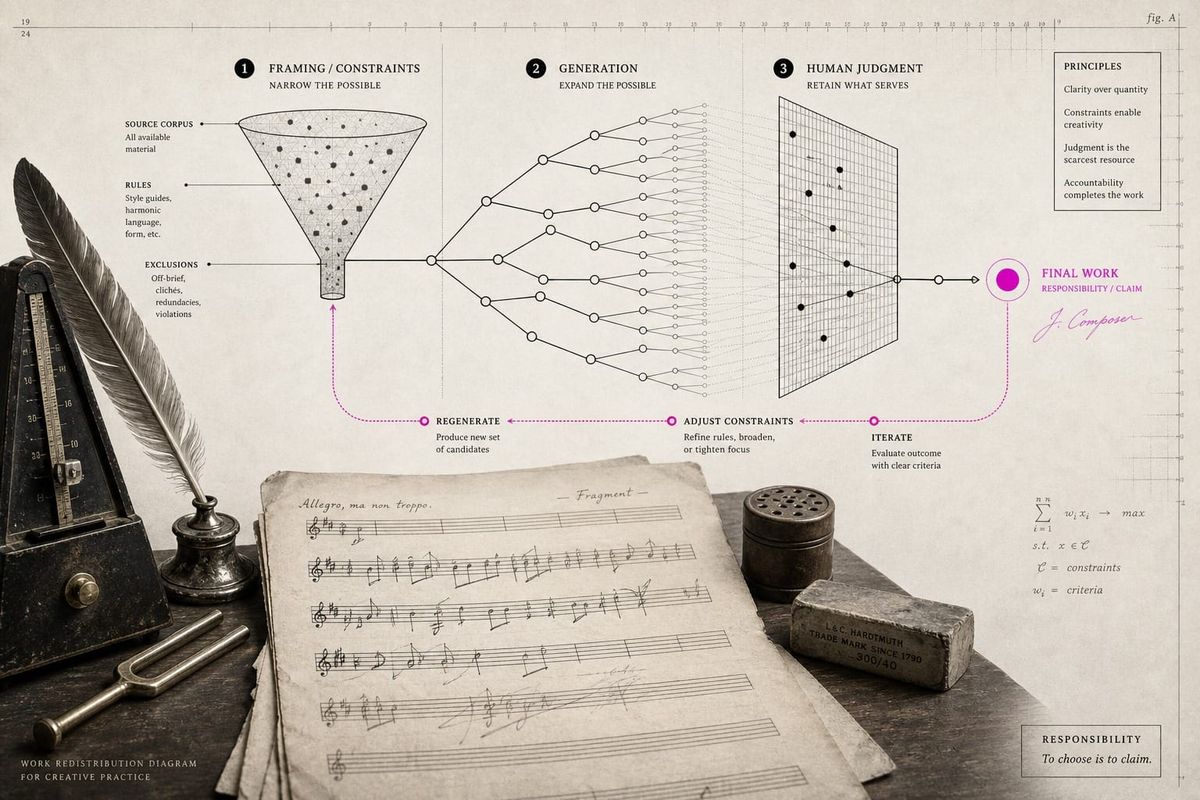
AI does not make creative work disappear. It moves the work toward framing, judgment, iteration, and responsibility.
Hello and welcome back to my newsletter!
On Monday, I spoke on a panel at the F.A.Z. AI Conference about a question that keeps coming back in every discussion about AI and art:
What happens to creativity when machines can generate?
The F.A.Z. article about the conference picked up one example from our discussion: the completion of Beethoven’s unfinished 10th Symphony, a project I worked on with Deutsche Telekom.
For that project, we built a music model trained on Beethoven’s style. You could call it a kind of music GPT before the term became common. The system could generate musical material that sounded plausible. It could continue fragments, offer variations, and suggest directions.
But that was not the interesting part.
The first output was never the work.
It was material.
A Prompt Is Not A Work
This is the part that gets lost in many AI debates.
People look at a generated image, a piece of text, or a melody and ask: “Did the machine make this?”
That is understandable, but it is usually the wrong question. The more useful question is: where did the work move?
In the Beethoven project, the work did not disappear. It moved from writing every note by hand to setting constraints, listening carefully, selecting, rejecting, editing, comparing, and shaping the output into something musically coherent.
The model could propose. It could not care.
It could continue a pattern. It could not decide whether that continuation belonged in Beethoven’s world.
That judgment still had to come from people.
Creativity Moves To The Edges
AI changes creative work by moving more of the effort to the edges of the process.
At the beginning, the human has to frame the problem. What is the system allowed to do? What material should it learn from? What counts as a good continuation? What should be excluded?
In the middle, the human has to iterate. Not once, but many times. Listen. Compare. Change the constraints. Try again. Notice when the system is becoming too predictable or too generic.
At the end, the human has to take responsibility. What is kept? What is removed? What is presented to the world? What does the final work claim to be?
That is not less work.
It is different work.
Co-Creation Is Not Surrender
The word co-creation can sound soft, as if it simply means “human plus machine.”
That is not enough.
Co-creation only becomes meaningful when both sides change the process. The machine expands the search space. It can generate paths a human might not have written first. But the human gives the process direction, taste, memory, and responsibility.
Without that, you do not get co-creation.
You get output.
And output is cheap now.
What matters is the system around the output: the constraints, the selection process, the editing, the context, the decision to stop.
The Copyright Problem Shows The Real Issue
The same shift appears in copyright.
If a work is generated entirely by a machine, most legal systems struggle to protect it because copyright is tied to human authorship. That makes sense. A machine does not have a personality, intention, or moral claim.
But most serious AI-assisted work is not that clean.
Generated fragments are selected, transformed, arranged, embedded, and combined with human material. At that point, the question is no longer whether the machine “made it.” The question is where the human contribution becomes substantial enough to deserve protection.
This will become one of the most important cultural questions of the next years.
Not because artists want special treatment, but because our legal and economic systems still assume that creation happens in recognizable human steps.
AI breaks that neat picture.
The Better Question
The old question was:
Can AI be creative?
I find that question less and less useful.
The better question is:
Which parts of creative work are being redistributed?
Some parts become easier. Generating variations, exploring a style, trying a direction, producing a rough draft.
Some parts become more important. Taste, judgment, context, ethics, editing, responsibility.
And some parts become more visible than before. The invisible labor after the first idea. The craft of working with material. The ability to know when something is not good enough.
That is why I do not think AI replaces creative work in a simple way.
It moves the work.
And once the work moves, the real task is to understand where it went.
You can read the F.A.Z. article about the conference here.
Have a great day!
Matthias